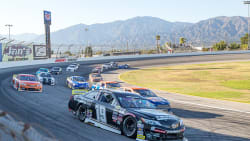
How Fast Do NASCAR Cars Go?

What Makes Them So Fast?
NASCAR Cup cars can approach 200 mph on the fastest tracks, but outright top speed tells only part of the story. Horsepower, aerodynamics, drafting, tires and even the shape of the racetrack all determine just how fast a NASCAR car can go.
By The Editors
Sun, Sep 27, 2026 08:37 PM PST
Featured image by Casey Calhoun.
If you've ever watched a NASCAR race and wondered just how fast those cars are actually traveling, the simple answer is: very fast. On NASCAR's biggest ovals, Cup cars can run at speeds approaching 200 mph, particularly when running together in a drafting pack.
But there isn't one definitive "NASCAR speed." A car that spends much of an afternoon near 190 mph at Daytona or Talladega will behave very differently on a short oval or a twisting road course. And that's part of what makes NASCAR interesting: the cars aren't simply built to go fast in a straight line. They have to work across dramatically different types of racetracks.
Top Speed vs. Average NASCAR Speed
One important distinction is the difference between top speed and average speed.
A NASCAR car might approach 200 mph at its fastest point on a large oval, but that doesn't mean it averages 200 mph over an entire race. Caution periods, pit stops, traffic, tire wear and, most importantly, corners all reduce average speeds.
Track layout makes an enormous difference. Daytona and Talladega allow drivers to carry tremendous momentum thanks to their long straights and steeply banked corners. Intermediate ovals combine high speeds with more braking and throttle management. Short tracks require considerably more slowing, turning and accelerating, while road courses add hard braking zones and corners in both directions.
In other words, asking how fast a NASCAR car goes is a little like asking how fast a sports car goes. The answer depends considerably on where you're driving it.
NASCAR Horsepower: There's More to Speed Than the Engine
NASCAR Cup cars use naturally aspirated V8 engines, but NASCAR regulates their output through different competition packages. That means the horsepower available can vary according to the type of track.
And horsepower alone doesn't determine speed.
LACar has previously gotten an up-close look at what NASCAR-style power feels like through a 625-horsepower NASCAR Yates Spec Engine, an excellent reminder that these aren't mildly modified street-car engines. They're purpose-built racing machines designed to operate under extreme loads for hours at a time.
More horsepower certainly helps a car accelerate, but adding power doesn't automatically produce a proportionate increase in top speed. At NASCAR velocities, the atmosphere itself becomes one of the biggest obstacles.
Aerodynamics: Fighting the Air at Nearly 200 MPH
The faster a race car travels, the more important aerodynamics become.
NASCAR teams spend enormous amounts of effort managing airflow around the car. They need enough downforce to keep the tires planted through corners, but generating downforce generally comes with aerodynamic drag—which works against top speed.
Then there is the difference between "clean air" and "dirty air." A car running by itself encounters relatively undisturbed airflow. A car following another vehicle has to deal with turbulent air coming off the car ahead, which can change how much aerodynamic grip it has.
That same airflow also creates one of NASCAR's most famous strategies: drafting.
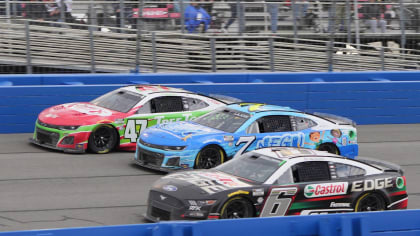
By following closely behind another car, a driver can take advantage of the reduced aerodynamic resistance in the leading car's wake. At superspeedways, groups of cars can form tightly packed drafting lines where drivers cooperate—at least temporarily—to maintain momentum.
Why Track Design Matters So Much
Banking is another reason NASCAR cars can maintain such remarkable speeds on certain ovals.
A steeply banked corner allows a car to carry more speed through the turn than it could through a comparatively flat corner. That's one reason a massive superspeedway produces an entirely different style of racing from a half-mile short track.
And it also explains why being fast at one kind of NASCAR track doesn't automatically translate into dominance everywhere else.
A successful driver and team have to contend with superspeedways, intermediate ovals, short tracks and road courses over the course of a season. That variety is also useful context when looking at things such as NASCAR championship odds: outright speed matters, but consistency across very different tracks, along with strategy, tire management and avoiding trouble, matters just as much.
Tires: The Four Small Contact Patches That Make It Work
Hundreds of horsepower don't accomplish much if the tires can't transfer that power to the pavement.
NASCAR tires are designed specifically for racing, and their grip changes as they heat up and wear. A fresh set can transform how a car accelerates, brakes and turns, while worn tires can force a driver to back off considerably.
Drivers and crew chiefs therefore have to balance speed against tire life. Push too hard early in a run and the car may lose grip later. Be too conservative, and competitors may simply drive away.
That's one reason the fastest car over a single lap isn't necessarily the fastest car over an entire race.
What Is the NASCAR Speed Record?
One number does stand above the rest.
On April 30, 1987, Bill Elliott qualified at Talladega Superspeedway at 212.809 mph, setting NASCAR's all-time qualifying speed record.
The number becomes even more impressive when you remember that 212.809 mph wasn't Elliott's speed at one instant on a straightaway. It was his average speed around the entire qualifying lap.
The record came before NASCAR introduced horsepower-reducing restrictor plates at its fastest superspeedways. Modern rules deliberately control speeds at tracks such as Daytona and Talladega, making Elliott's record a remarkable snapshot of a very different era in stock-car racing.
Speed Is Only Part of the Equation
So, how fast do NASCAR cars go?
On the fastest tracks, close to 200 mph. But the more interesting answer is that NASCAR cars have to be fast almost everywhere—and in very different ways.
A superspeedway rewards aerodynamic efficiency, drafting and momentum. A short track emphasizes braking, acceleration and mechanical grip. A road course demands precise cornering and car control.
Horsepower gets the headlines, but combining that power with aerodynamics, tires, chassis setup, track design and driver skill is what makes a NASCAR Cup car truly fast.
And doing it while surrounded by dozens of other cars at racing speed? That's where the job gets considerably more complicated.
Frequently Asked Questions
Can a NASCAR car go 300 mph?
No. Current NASCAR Cup cars are neither designed nor configured to approach 300 mph, and NASCAR deliberately regulates performance at its fastest tracks.
What is the fastest recorded NASCAR speed?
Bill Elliott's 212.809-mph qualifying lap at Talladega Superspeedway in 1987 remains NASCAR's all-time qualifying speed record.
Are NASCAR cars slower than they used to be?
At the fastest superspeedways, NASCAR has intentionally controlled speeds through changes to engine output and aerodynamic packages. However, rules vary by track type and have continued to evolve.
Does horsepower determine how fast a NASCAR car goes?
Horsepower is important, but it is only one factor. Aerodynamic drag, downforce, gearing, drafting, tire grip, track banking and corner layout all affect how quickly a NASCAR car can travel.